

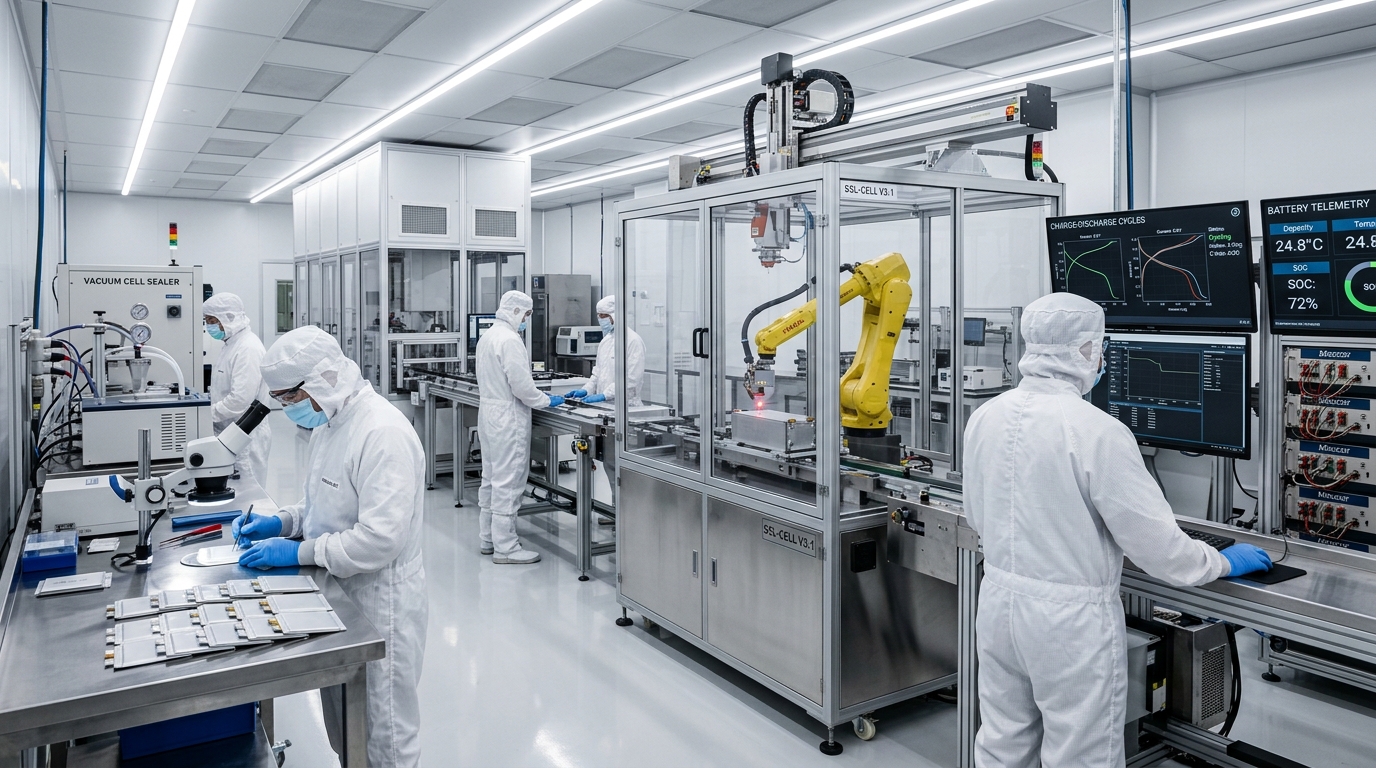
Core Foundations of New Battery Technology.
New battery technology powers clean energy. Early gear used basic lithium cells. They ran on liquid organic electrolyte mixes. Those cells mixed carbonate solvent liquids. They used a basic graphite anode. Liquid cells dissolve lipf6 salt. But old cells face limits in big energy storage systems. Today, next generation energy storage expands. It branches into new paths. Teams build solid state battery packs. They test sodium ion battery units. They build high-rate silicon anode foils. These cells pack more juice. They take less space. Packs charge fast. Cells run cool. Clean packs store green power. Cells run cool. Packs charge fast.
Plants scale up gigafactory production to cut cost. Teams craft direct cell to pack layouts. New electric vehicles use direct cell to chassis frame mounts. This design brings great range extension. This design boosts the ev powertrain. It eliminates dead pack weight. Cars gain extended driving range. Large battery energy storage systems back up power grids. Large bess plants guard the line. Stationary energy storage guards the line. Reviewing electronic engineering technology shows how sensor lines check high-voltage rails. Sound cell design builds great packs. Cells store power day and night. Rigs run smooth. Good packs hold juice.
Key Assembly Targets.
- Mass Target: Reach 500 watt hours per kilogram cell specific energy.
- Bulk Target: Surpass 1,000 watt hours per liter in tight pack shells.
- Charge Goal: Deliver 4C to 6C extreme fast charging in ten minutes.
- Life Goal: Retain over 80 percent capacity through 2,000 full loops.
The Shift Beyond Liquid Lithium Cells.
Old cells move ions through wet solvent baths. Solvents can leak. High heat makes liquid solvents flame up. Fires can start. In contrast, new battery technology deploys a non flammable electrolyte. Solid ceramics kill fire risks. Dry polymers stop shorts. Flammability drops to zero. Post lithium technology avoids scarce ores. Safe sodium salt replaces rare cobalt. Cheap iron ores cut cost. Zinc air battery systems store bulk grid power. Iron air battery units run for days. Iron air battery units run for days. Grid teams test the redox flow battery. It serves long duration needs. Clean packs cut carbon footprints. They save cash. Green packs win.
Solid-State Battery Chemistries and Electrolyte Physics.
The all solid state battery replaces wet fluids with a solid electrolyte. An assb cell pairs a pure lithium metal anode with a dense cathode material. Layers stay flat. A solid ceramic separator acts as the core ionic path. It guides the ions. This barrier stops internal short circuit faults. Packs stay intact. Cells hold strong charge. Ions cross solid paths. Solid state electrolyte layers stop fire risks. Cells stay safe under high stress. Tests prove real gains. Chips run fine.
Electrolyte Families: Sulfides, Oxides, and Polymers.
Engineers evaluate three primary solid families:
- Soft Sulfides: A sulfide electrolyte like lpscl argyrodite yields high room-temperature ionic conductivity. Ions flow with ease. High transference number rates speed ion flow. Salts move fast. Low activation energy aids fast pulse power. Cells crank high amps. Soft grains yield under stack pressure. They stay tight.
- Garnet Oxides: An oxide electrolyte like llzo garnet structure gives a wide electrochemical window. Rigid lisicon ceramics add stability. They stay stable against a lithium metal battery core.
- Tough Polymers: A dry polymer electrolyte blends dry salts into solid films. Gel polymer films cut costs. They run on smooth roll to roll manufacturing lines. Lines run at low cost.
Stopping Lithium Dendrites and Interfacial Resistance.
Solid interfaces face mechanical stress. Hard grains resist ion flow. They build grain boundary resistance zones. Interfacial resistance slows down rapid charge rates. Heat can rise. Plating and stripping can cause lithium dendrites to grow. Sharp spikes form. These sharp needles cause dangerous lithium plating. They trap dead lithium bits. Cells need tight dendrite suppression. Factories apply a thin nano buffer layer. They use atomic layer deposition. High stack pressure stops crack growth. Layers hold tight.
Near-term plants build the semi solid battery. This hybrid electrolyte system wets a ceramic separator. It adds trace fluids. A semi-solid pouch cell gives high specific energy. It holds high safety margins. Cells pass tough crash checks. They do not burst.
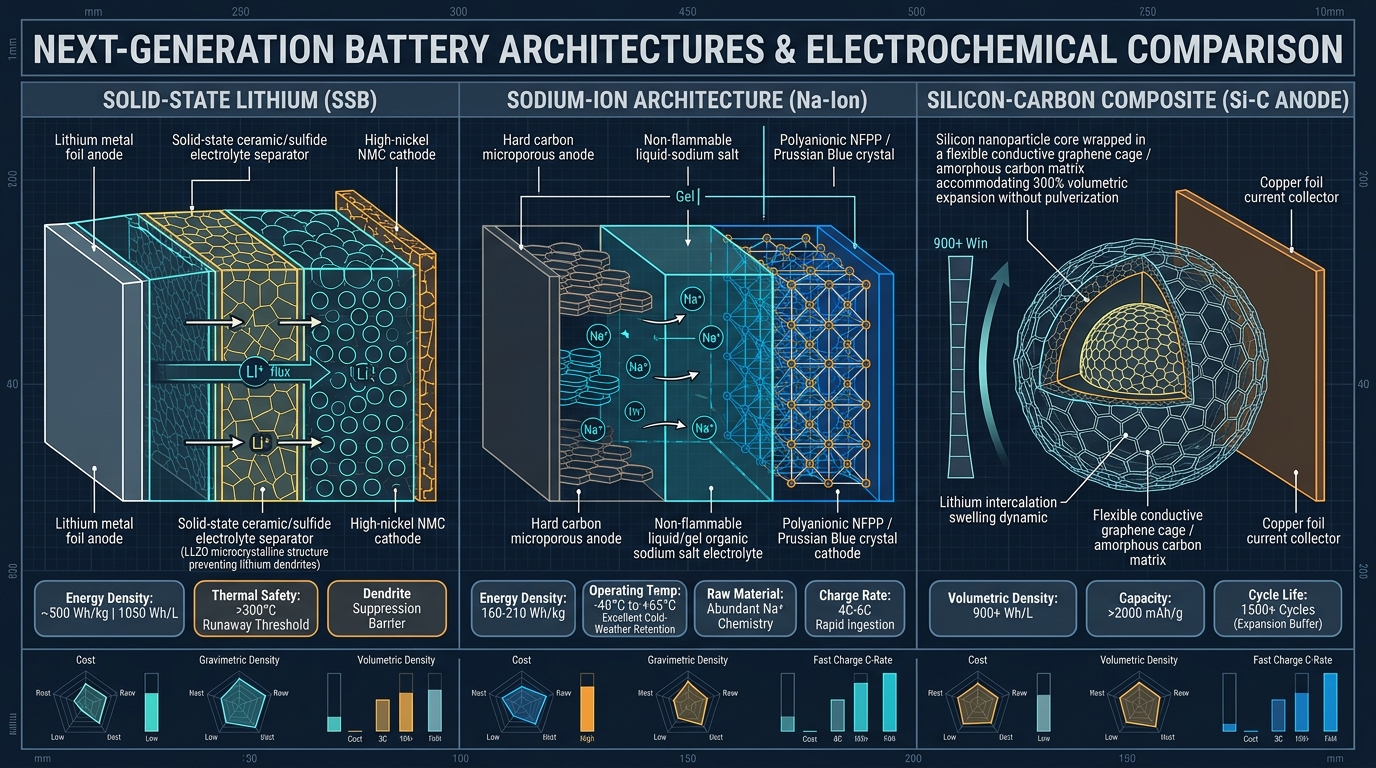
Figure 1.0: Next-generation battery technology schematic detailing solid-state lithium cells, sodium-ion grid layers, and silicon-carbon composite expansion buffer architectures.
Silicon Anodes and Interfacial Stress Control.
Graphite anode plates hold 372 mAh/g. Silicon anode materials hold over 3,500 mAh/g. They store vast charge. Yet silicon swells during deep charge. It suffers volumetric expansion past 300 percent. The foil swells up. The anode undergoes fierce anode breathing. Swelling strains the foil. Swelling causes particle pulverization. The fragile solid electrolyte interphase cracks open. Repeated sei layer growth causes rapid capacity fade. It steals active ions. It wastes active lithium.
Silicon-Carbon Composites and Graphene Cages.
Material labs build a silicon carbon composite. A flexible graphene cage encases small silicon grains. A mesh of carbon nanotubes wraps each core. This hollow shell leaves room for safe expansion. Grains swell freely. It protects the artificial sei from mechanical stress. Shells do not crack. High-grade cells blend 15 percent si c composite into graphite slurries. Mixes stay smooth. This mix lifts volumetric energy density past 900 wh l. First cycle efficiency stays high. Capacity retention beats old cells. Cells charge fast without cracks. Thin copper foil backs each sheet. Foils stay flat. They hold true.
Sodium-Ion Technology for Grid Energy Storage.
Solid-state cells power premium electric vehicles. In contrast, the sodium ion battery powers utility grids. A na ion cell uses cheap soda ash instead of scarce lithium salt. Sodium cells use cheap aluminum foil on positive and negative poles. Foils save cash. They ditch heavy copper foil current collector sheets. Weight drops down. Raw material abundance keeps pack costs low. Abundant ores grant strong supply chain resilience. Sustainable materials protect plant costs. Lines run fast. Teams ship packs.
Cathode Lattices: Prussian Blue and Polyanionics.
Sodium ions are large. Cathodes need wide lattice channels for smooth intercalation and deintercalation. Layered transition metal oxides give high voltage in small cans. For stationary energy storage, polyanionic compounds lead the field. They power big bess plants. Sodium iron pyrophosphate known as nfpp gives high thermal stability. Cells stay cool. Prussian blue analogues resist lattice collapse. Cages hold shape. They yield long cycling stability. They run through thousands of loops.
Hard Carbon Anodes and Cold-Weather Kinetics.
Sodium ions do not fit in soft carbon or graphite. Instead, cells use hard carbon with wide pores. Hard carbon stores sodium through adsorption. Pores trap salt ions. These cells excel at low temperature performance. They work in subzero ambient temperature zones. They keep 85 percent capacity at minus 40 degrees Celsius. In cold weather, sodium packs start fast. They offer an outstanding levelized cost of storage. Low lcos aids renewable integration. It helps peak shaving.
Advanced Cathode Chemistries and Phase Stability.
Cathode choice sets pack voltage and total cost. Stable crystal frameworks preserve lattice stability. They ensure smooth ion transfer without cathodic degradation.
High-Nickel and Cobalt-Free Blends.
Long-range automotive packs deploy high nickel cathode blends. They use nmc 811 and nmc 955. This nickel rich chemistry cuts costly cobalt. It lifts gravimetric energy density to 300 wh kg. Protective coatings shield the cathode electrolyte interphase. This cei layer prevents unwanted phase transition shifts. It stops oxygen release at high heat. Ultra-stable cells deploy lithium titanate anodes for long life. Tough lto anodes run for 20,000 cycles. Future cells also test high voltage spinel materials and cobalt free cathode mixes.
Utility packs rely on lithium iron phosphate. Upgraded lithium manganese iron phosphate adds manganese. It lifts nominal potential to 3.7V. This lmfp blend lifts power density. It adds no fire risk. High-rate cells use conductive carbon and tough pvdf binder material on foils. Research teams also test the lithium sulfur battery. It uses a pure sulfur cathode. A pure sulfur cathode gives extreme power density. It delivers high specific power. It yields top w kg output.
Empirical Benchmarks for Next-Generation Battery Chemistries.
Choosing the right battery chemistry requires balancing specific energy, cycle life, thermal limits, and raw material access. Engineers rely on benchmark data to size energy storage systems.
| Battery Chemistry | Specific Energy | Volumetric Density | Cycle Life (80% DoD) | Fast Charge Rate | Thermal Runaway Limit |
|---|---|---|---|---|---|
| Lithium Iron Phosphate (LFP) | 160–185 Wh/kg | 350–420 Wh/L | 3,500+ cycles | 2C (30 min) | > 270 °C |
| High-Nickel NMC-811 (Liquid) | 260–300 Wh/kg | 650–750 Wh/L | 1,500 cycles | 3C (20 min) | ~ 210 °C |
| Silicon-Carbon Anode (Si/C) | 320–380 Wh/kg | 800–920 Wh/L | 1,200 cycles | 4C (15 min) | ~ 200 °C |
| Solid-State Lithium (LLZO/Sulfide) | 400–500 Wh/kg | 950–1,100 Wh/L | 2,000+ cycles | 6C (10 min) | > 350 °C |
| Sodium-Ion (Hard Carbon / NFPP) | 140–165 Wh/kg | 280–330 Wh/L | 4,000+ cycles | 5C (12 min) | > 300 °C |
Battery Management Systems and Telemetry Controls.
High-energy packs need smart electronic monitoring. A digital battery management system supervises every cell. The bms controller coordinates an analog front end chip. It reads millivolt steps. Reviewing integrated device technology shows how precision clock chips and converters stabilize high-speed sensor buses. Assembly follows strict surface mount technology rules to solder current sensors and high voltage busbar joints. Lines join contactor relays with thick copper links. Heavy switches cut off faults.
State Estimation and Active Cell Balancing.
The system monitors voltage, current, and temperature at fast sample rates. Digital voltage monitoring tracks each node. Chips check every tap. Continuous temperature monitoring spots local hot spots. Sensors warn of heat. Fast can bus communication links modules to car computers. Data moves in real time. Sensors run early thermal runaway detection loops. Logic stops bad shorts. Firmware runs state of charge estimation code. Code tracks state of health. Code runs extended kalman filter math. Systems match coulomb counting against a stored ocv curve. Math maps open circuit voltage curves. Cells operate in a safe operating temperature band.
When cells drift, active balancing shunts charge between neighbors. Shunts move amps. Passive balancing burns excess charge. Small bleed resistors drain excess volts. This control lifts pack level density. It minimizes coulombic losses. It curbs self discharge rate loss. It keeps cell degradation and impedance growth low.
Automated Battery Cycler Test Automation.
Validation labs test prototype cells with an automated charge discharge cycler. Engineers write Python scripts using standard SCPI commands to check cell capacity, coulombic efficiency, and internal charge transfer resistance.
SCPI Automated Battery Cycler Telemetry Script
import pyvisa
import time

rm = pyvisa.ResourceManager()
cycler = rm.open_resource("TCPIP::192.168.1.150::INSTR")

# Set 1C discharge rate to 2.5V cutoff
cycler.write(":SOUR:CURR:LEV:IMM -5.0")
cycler.write(":SOUR:VOLT:PROT 2.50")
cycler.write(":OUTP ON")

start_time = time.time()
while True:
    v = float(cycler.query(":MEAS:VOLT:DC?"))
    i = float(cycler.query(":MEAS:CURR:DC?"))
    t = float(cycler.query(":MEAS:TEMP?"))

    print(f"Cell Test | V: {v:.4f}V | I: {i:.2f}A | T: {t:.1f}C")
    if v <= 2.50:
        print("Cutoff reached. Discharge cycle complete.")
        cycler.write(":OUTP OFF")
        break
    time.sleep(1.0)
Code 1.0: Python PyVISA test script logging battery cell discharge kinetics.
Electrochemical Impedance Spectroscopy Diagnostics.
Advanced labs deploy electrochemical impedance spectroscopy. High-frequency eis scans detect micro-shorts. They trace sei layer growth before faults spread. Engineers track overpotential across wide depth of discharge bands. They track rate capability. Rigs test high c rate surges. They test xfc charge pulses. Cyclic voltammetry tests check half cell test samples. They test cells before full cell validation. Diagnostic scans stop faults early. Scans check each cell. Tests run day and night. Cells pass test.
Safety Standards and Thermal Runaway Mitigation.
Dense packs store large amounts of power. An internal fault can trigger thermal runaway. Cells exceed their critical temperature threshold and release gas. Severe gas generation builds internal pressure. A smart thermal management system guards the pack. Automated fire suppression units stop sparks. Packs must stop fire spread.
Cell-Level and Pack-Level Safety Defenses.
Engineers design multi-layer defenses to contain thermal runaway events:
- Ceramic Layer: A tough ceramic coating guards the separator shutdown layer. It holds if heat spikes.
- Vent Disc: A directional venting mechanism vents hot gas. Ports route gas through side exhaust channels.
- Cooling Plate: An extruded liquid cooling plate pumps glycol water. Cold fluid sweeps beneath high-rate cells.
- Immersion Fluid: Advanced packs use immersion cooling. They soak cells in dielectric fluid for fast heat removal. Phase change material wraps can also absorb heat spikes.
Every commercial module undergoes strict safety testing. Destructive audits run the nail penetration test. Tests run overcharge protection checks and over discharge tests. Enclosures must pass ul 9540a, un 38.3, and iec 62619 standards from the U.S. Department of Energy guidelines. Certified packs run safe. Safe cells win. Tests show zero faults.
Advanced Gigafactory Manufacturing and Dry Coating.
Standard electrode manufacturing uses wet slurry coats with toxic solvents. Slot die coating heads spread wet slurry on foil. Huge drying ovens consume heavy plant power. Next-generation plants use dry electrode coating. Dry active powders bind under high-pressure rolls. Heated calender roll machinery binds foils. Automated electrode slitting blades slice rolls. They cut foils with clean edges. This dry step removes solvent recovery costs. It boosts volumetric efficiency and cuts plant energy use by 40 percent.
Robotic lines use precision z stacking or cell winding. They build pouch cell, cylindrical cell, and prismatic cell cores. Automated tab welding heads join foil flags. High-power ultrasonic welding joins tab foils. Laser welding seals tabs with zero spatter. Automated electrolyte filling pumps inject salts under tight vacuum. Sealed cells enter multi-week formation cycle rooms. They sit in warm aging process rooms. Computed tomography scans verify layer alignment. X ray inspection spots hidden bent foils. Scanning electron microscopy inspects particle bonds. Rapid sem analysis checks grain bonds. Clean lines build reliable energy storage systems. Lines hum day and night. Packs run well.
Engineering Verdict: Scaling Next-Gen Energy Storage.
New battery technology transforms global energy and transport. Solid-state cells deliver high specific energy and safety for mobile transport. Sodium-ion cells provide low-cost, fire-safe storage for electric grids. Battery recycling reclaims critical ores. Hydrometallurgical recycling feeds a circular economy. Second life batteries serve back-up power roles before recycling. Old cells gain new life.
By pairing silicon-carbon composite anodes with dry coating and smart bms telemetry, engineers achieve record energy efficiency. Solid electrochemistry and sound pack design deliver clean, scalable power for global grids. Clean packs power the globe. Clean tech wins. Green power rules the grid.